Rebates
How to Apply for Home Renovation Savings in Ontario in 2026
Home Renovation Savings application steps Ontario 2026, from eligibility checks and quotes to photos, invoices, claim submission, and follow-up.

Home Renovation Savings application steps Ontario 2026 can feel confusing because the right order depends on the upgrade, the rebate stream, and whether an energy assessment is required before work begins. Start by treating the application like a paper trail, not a shopping trip, because the easiest mistake is buying first and trying to fit the paperwork around it later.
For most homeowners, the safest plan is simple: confirm the route, document the house as it is today, get a quote that matches the program rules, then submit a clean claim package after the work is finished. That takes a little discipline up front, but it can save weeks of back-and-forth.
| What you see | Likely cause | First move |
|---|---|---|
| You are not sure whether to book an energy assessment | The upgrade may be on the assessment-required path | Check the current program page before signing a quote |
| Your contractor says the rebate is automatic | They may be simplifying the claim process | Ask for the exact rebate stream and required documents in writing |
| The quote lists a broad upgrade name only | The model, quantity, or scope may be too vague | Request a revised quote with itemized details |
| You already paid a deposit | The application order may be at risk | Pause further work until you confirm eligibility and proof rules |
| Your claim is delayed after submission | Photos, invoice details, or payment proof may be incomplete | Resubmit a tidy folder with missing items clearly labelled |
What you need before you start
Gather your basic property details, recent utility information, photos of the area being upgraded, and any contractor quote you are considering. Keep a single digital folder for the project so you can find files quickly when the program asks for them.
- Property address and homeowner contact details.
- Current photos of the equipment, windows, insulation area, or other upgrade location.
- Contractor quote with itemized scope, model numbers where relevant, and total cost before tax and after tax.
- Any program emails, preapproval notices, assessment reports, invoices, and payment receipts.
- A notes file showing dates: quote received, assessment booked, work started, work completed, claim submitted, and payment received.
Home Renovation Savings application steps Ontario 2026: the short version
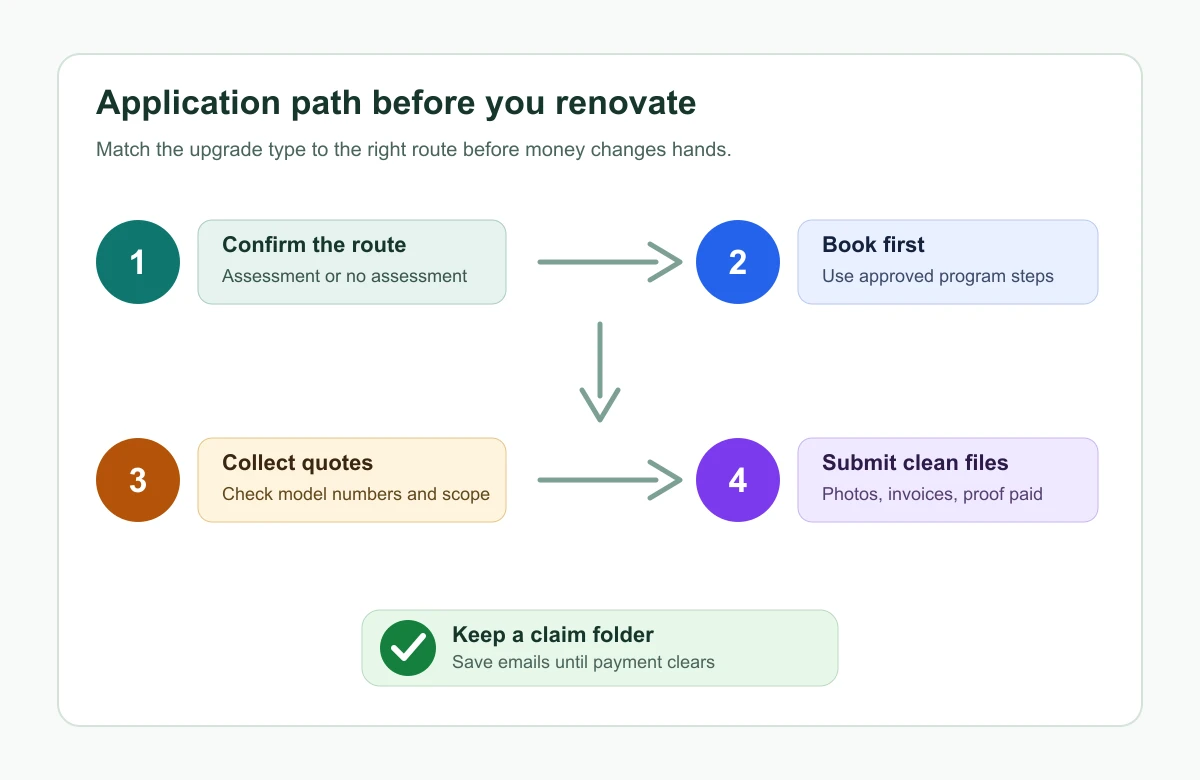
- Estimated time: 20 to 30 minutes. Decide which upgrade you are applying for and whether it belongs to the energy-assessment route or a direct rebate route.
- Estimated time: 1 to 3 days. If an assessment is required, book it before the project starts and keep the confirmation email.
- Estimated time: 2 to 7 days. Ask contractors for quotes that match the rebate category instead of vague renovation language.
- Estimated time: 10 to 20 minutes. Take before photos before equipment is removed, insulation is covered, or old windows are taken out.
- Estimated time: 30 to 60 minutes. After installation, submit the final claim with invoices, payment proof, photos, and any required reports.
That order matters. Honestly, most rebate problems are not about whether the homeowner wanted an efficient upgrade. They happen because the claim file cannot prove the work matched the program rules.
Step 1: Match your upgrade to the right route
Estimated time: 20 to 30 minutes. Start with the upgrade, not the contractor pitch. Home Renovation Savings covers different types of home efficiency work, and the application path can change depending on whether you are replacing windows, adding insulation, installing a heat pump, planning solar battery storage, or combining multiple measures.
Use the official program page to check whether your project needs a home energy assessment first. If you are trying to decide whether the paperwork is worth the effort, compare your project against Ontario home renovation rebate value in 2026 before you spend time chasing a small claim.
Windows and doors are a common example. One homeowner may only need a direct product path, while another may be pulled into a broader assessment route because of the upgrade mix. Review whether Ontario window and door rebates require an energy assessment and how the Ontario window rebate per opening works before you count savings in your budget.
Step 2: Book any assessment before work begins
Estimated time: 1 to 3 days to book, plus the appointment. If your upgrade path requires an energy assessment, book it before demolition, installation, or material delivery. The assessment creates a baseline for the home, and trying to recreate that baseline after the work is done can turn a strong claim into a weak one.
Heat pump projects need extra care because equipment type, income stream, and assessment route can all affect the rebate path. Read what actually counts for Ontario heat pump rebate income eligibility and how the heat pump water heater assessment path works if either upgrade is on your list.
Assessment costs also belong in the budget. Before booking, check Ontario energy advisor costs and rebates so the appointment fee does not surprise you.
Step 3: Get quotes that match the rebate rules
Estimated time: 2 to 7 days. Ask for quotes that describe the upgrade the way the program will review it. A quote that says "attic work" is less useful than one that lists the starting condition, target R-value, covered area, material, and total price.
Insulation claims are especially detail-heavy. If your project includes attic work, start with how Ontario attic insulation R-value tiers work. For exterior walls, use the Ontario exterior wall insulation rebate guide. For basement projects, compare basement air sealing rebate rules with whether basement insulation needs an assessment.
Contractor paperwork is not just admin. Use the Ontario rebate contractor quote checklist and insulation quote questions to ask before signing to tighten the estimate before the work starts.
Step 4: Protect yourself before you pay
Estimated time: 30 to 45 minutes. Before you approve the job, make sure the contractor name, business details, product information, and invoice format will support the claim. A low quote can become expensive if it leaves you without the evidence the program needs.
Be cautious with door-to-door pressure, rebate guarantees, or anyone who asks you to sign quickly because funding is supposedly about to disappear. Run the invoice and sales claims through Ontario energy rebate scam warning checks before handing over a deposit.
Window projects deserve one more pass because the invoice often needs to prove opening counts and installed products. Keep the Ontario window rebate contractor invoice checklist beside the quote so you can catch missing details early.
Step 5: Take photos before and after the work
Estimated time: 10 to 20 minutes before, then 10 to 20 minutes after. Photos should show the actual area being upgraded, not just a close-up that could belong to any house. Take wide shots, label shots, and a few angles that prove the old condition and the finished installation.
For many claims, before-and-after photos are the simplest way to show that the project happened at your property and matched the quote. Use Ontario rebate photo requirements for 2026 claims as your photo list, then store the original files without resizing them.
Smart thermostat projects can be quick, but they still need the right order if a code or preapproval step applies. If that is your upgrade, check whether to buy now or get the Ontario smart thermostat rebate code first.
Step 6: Submit the claim and watch for follow-up
Estimated time: 30 to 60 minutes. Submit the application when the work is complete and your file is tidy. Upload the invoice, proof of payment, photos, assessment documents if required, and any program-specific forms in one sitting if possible.
Payment proof is where small errors slow claims down. Follow the Home Renovation Savings payment proof checklist so the file clearly shows what was paid, who was paid, and when the payment cleared.
After submission, save the confirmation number and watch your email. If the rebate does not arrive when expected, use the rebate cheque status guide before resubmitting anything.
How to handle bigger project combinations
Some homeowners apply for one upgrade. Others use the program as part of a bigger retrofit plan, and that is where the order gets more important.
If you are combining provincial rebates with federal financing, review what still works with the Canada Greener Homes Loan and Ontario rebates. Loan timing, contractor deposits, and rebate payment timing are separate cash-flow questions, and mixing them casually can make the budget look better than it really is.
Solar and battery work may need preapproval before you buy equipment. Use the Ontario solar battery rebate preapproval guide before signing a storage quote.
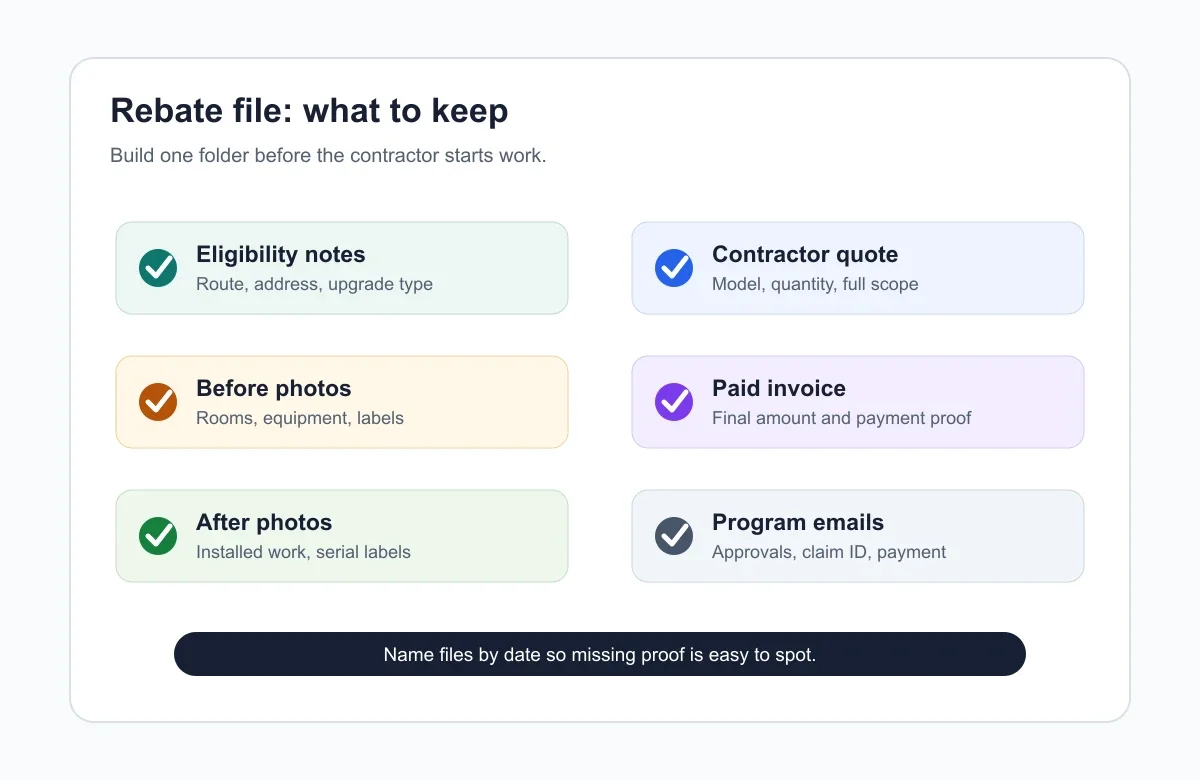
Bundled upgrades can be useful, but do not let a bundle blur the paperwork. Each measure should still have its own quote details, photos, invoice lines, and eligibility notes.
Quick Checklist
- Confirm whether your upgrade needs an energy assessment before work starts.
- Save the current official program page you used to make your decision.
- Get an itemized quote with model numbers, quantities, scope, and taxes.
- Take before photos before anything is removed or covered.
- Keep paid invoices, receipts, assessment reports, emails, and claim IDs together.
- Submit the claim only when every required file is ready.
- Track payment follow-up without creating duplicate applications.
Sources checked
Official sources: Home Renovation Savings assessment-required upgrades · Enbridge Gas rebates and energy conservation. Check current program pages before applying.
A careful application is mostly about sequencing. Confirm the route first, document the house before work starts, keep the quote and invoice specific, and make the final claim easy for a reviewer to approve.
Frequently Asked Questions
How do I apply for Home Renovation Savings in Ontario?
Start by choosing the upgrade, checking whether an energy assessment is required, and gathering a quote that matches the program rules. After the work is complete, submit the claim with invoices, proof of payment, photos, and any required assessment documents.
Do I need an energy assessment for Home Renovation Savings?
Some upgrades require an initial home energy assessment before the work starts, while others may follow a direct rebate route. Check the current program page for your exact upgrade before you book contractors or buy equipment.
Can I apply after the renovation is already finished?
You may have trouble if the program required preapproval, an assessment, or before photos. Check the official rules for your upgrade, then gather every invoice, payment record, and photo you still have before asking about next steps.
What documents do I need for an Ontario home renovation rebate?
Expect to keep eligibility notes, contractor quotes, before-and-after photos, final invoices, payment proof, assessment reports if required, and program emails. The exact list depends on the upgrade stream.
How long does a Home Renovation Savings rebate take?
Timing depends on the claim volume and whether your file is complete. A clean application with clear invoices, payment proof, photos, and assessment documents is less likely to get delayed by follow-up questions.