Insulation
2026 Ontario Insulation Rebates: Quote Questions to Ask Before You Sign
Use these Ontario insulation rebate contractor quote questions 2026 to compare scope, paperwork, payment terms, photos, and rebate risks.

Ontario insulation rebate contractor quote questions 2026 can save you from two expensive problems: paying for work that does not match the rebate stream, and trying to fix missing paperwork after the attic or wall cavity is already closed. A good quote should make the rebate path, insulation scope, proof photos, invoice details, and payment timing clear before you agree to the job.
Rebate rules can vary by upgrade type and program path, so treat the quote meeting as a documentation check, not just a price conversation. You are trying to learn whether the contractor can install the work and leave you with a clean claim file.
| What you see | Likely cause | First move |
|---|---|---|
| One lump-sum price | Scope, tax, and labour are not separated | Ask for an itemized version before comparing bids |
| No R-value listed | The quote may not prove the upgrade level | Ask for current and target R-values where applicable |
| Contractor says they will "handle the rebate" | Role and responsibility are vague | Ask exactly who submits, uploads, and keeps copies |
| Large deposit requested | Payment risk is moving to you early | Ask for milestones, holdback, and cancellation terms |
| No photo plan | Proof may be missed once work starts | Assign before, during, and after photo responsibility |
What you need before the quote call
Give yourself 20 minutes to gather the basics. You do not need a perfect energy file, but you do need enough information to stop vague quotes from sliding through.
- Your address, utility type, and main heating fuel.
- The area you want insulated: attic, cathedral ceiling, flat roof, exterior wall, basement, foundation header, crawl space, or exposed floor.
- Any past energy assessment report, if your project is using an assessment-based path.
- Photos of the area before work, especially attic depth markers, exposed framing, basement headers, and access points.
- The rebate page or program stream you believe applies.
- A blank note file where you can record each contractor's answers in the same order.
Step 1: Confirm the program path before discussing price (15 minutes)
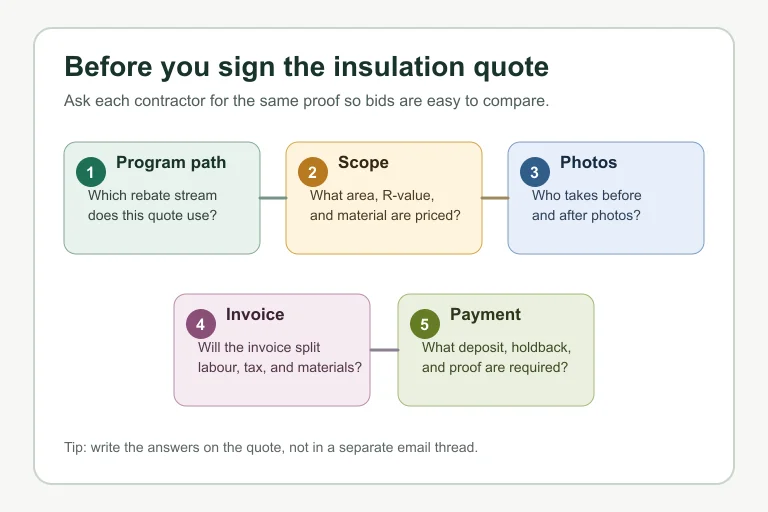
- Ask which rebate stream the contractor is quoting for. Say it plainly: "Is this for the current Home Renovation Savings insulation stream, an assessment-based stream, or another offer?"
- Ask how they confirm eligibility. A useful answer mentions the home, heating source or grid connection where relevant, the upgrade type, and the current program requirements. A weak answer sounds like "everyone qualifies."
- Ask whether an energy assessment is needed. Attic-only paths and assessment-based projects can have different paperwork. If the contractor cannot explain the difference, pause the quote.
- Ask what happens if the program changes. Rebates can be updated, paused, or capped. The contract should say whether you still owe the same price if the expected rebate is lower than planned.
Keep this step separate from price negotiation. Honestly, most quote problems start when the homeowner talks about dollars before confirming the claim route.
Step 2: Use these Ontario insulation rebate contractor quote questions 2026 before you sign (25 minutes)
Once the contractor says the project fits a rebate path, move into the quote itself. You are looking for answers that would still make sense six months later when someone reviews the file.
- What exact area is included? Ask for attic, flat roof, cathedral ceiling, exterior wall, basement wall, foundation header, crawl space, or exposed floor to be named in writing.
- What existing R-value or condition is assumed? If the contractor cannot inspect part of the space, ask them to mark that assumption clearly.
- What target R-value or added R-value will the work meet? Do not accept "top up insulation" as the only description.
- What material is being installed? Ask for product type, approximate depth or thickness, ventilation treatment, air sealing assumptions, and any areas excluded for access or safety.
- What part of the quoted total is rebate-eligible? Some invoices bundle related repairs, access work, ventilation changes, or disposal. Ask what the program may not count.
- Who answers rebate questions after installation? Get a named company contact or service channel, even if the backend assigns the final submission steps to you.
Step 3: Separate rebate paperwork from installation promises (30 minutes)
A contractor can do solid installation work and still leave you with weak documentation. Treat paperwork as part of the job.
- Ask for an itemized quote. It should separate labour, materials, tax, eligible insulation work, optional extras, and exclusions.
- Ask what the final invoice will show. The final invoice should line up with the quote closely enough that a rebate reviewer can connect the work to the claim.
- Ask who keeps photo evidence. Before and after images matter most when the upgrade will be hidden after installation. If the contractor takes photos, ask how you receive copies.
- Ask what proof of payment is acceptable. A credit card receipt, e-transfer confirmation, cancelled cheque image, or paid invoice may be needed, depending on the process.
- Ask how warranty language is delivered. Keep warranty paperwork separate from rebate paperwork, but collect both before closing the file.
Watch for soft language. "We do this all the time" is not a document, and it will not help much if the claim is questioned later.
Step 4: Build a photo and access plan before work starts (20 minutes)
Photos are easiest before the crew arrives. After insulation is blown in or wall areas are covered, proof can become messy fast.
- Take your own starting photos. Capture wide shots, close-ups, access hatches, attic rulers if visible, basement headers, rim joists, and any problem areas.
- Ask the contractor what they photograph. The answer should include before, during, and after images when practical.
- Ask whether all eligible areas are accessible. If a section cannot be reached, get that exclusion in writing before work begins.
- Ask how ventilation and moisture risks are handled. Insulation work can interact with baffles, soffits, bath fans, vapour control, and old moisture staining.
- Ask for a same-day document handoff. Do not wait weeks for a final invoice or photo set if a rebate deadline is approaching.
For a deeper look at photo proof, use the guide to Ontario rebate photo requirements for 2026 claims. It pairs well with the Home Renovation Savings payment proof checklist when you are building your claim folder.
Step 5: Compare the quotes without getting distracted by the rebate estimate (35 minutes)
Rebate math can make a weak quote look better than it is. Compare the base work first, then look at the expected rebate.
- Line up scope side by side. Compare area, material, R-value target, exclusions, ventilation work, and cleanup.
- Check the paperwork promise. Give extra weight to the contractor who explains invoices, photos, and payment proof clearly.
- Question rebate guarantees. A contractor can estimate based on current rules, but they should not pretend they control final program decisions.
- Review payment timing. Avoid paying the full amount before receiving the final invoice, proof of payment record, warranty, and photo set.
- Pick the quote you can document. Saving a few hundred dollars can backfire if the cheaper quote leaves out the details needed for a claim.
If the quote feels rushed, compare it against the broader Ontario rebate contractor quote checklist and the Ontario energy rebate scam warning invoice checks. A legitimate contractor should not object to basic documentation questions.
Related planning guides
Use these next if the quote touches another upgrade or a different paperwork path.
- For attic depth and targets, read the Ontario attic insulation R-value rebate tiers and the attic insulation rebate deadline checks.
- For wall or basement projects, compare Ontario exterior wall insulation rebates in 2026, basement insulation assessment requirements, and basement air sealing rebate rules.
- For air sealing proof, check the air sealing blower door test guide.
- For assessment-based planning, review Ontario energy advisor costs and rebates, the window and door energy assessment rules, and the heat pump water heater assessment path.
- For invoice examples, compare the window rebate contractor invoice checklist.
- For portal and payment timing, use the Home Renovation Savings application portal guide and the Home Renovation Savings rebate cheque status guide.
- For heat pump projects quoted with insulation, check the heat pump rebate pre-approval checklist, propane to heat pump rebate checks, oil to heat pump rebate checks, and participating contractor list checks.
Quick Checklist
- Confirm the rebate stream and whether an energy assessment is required.
- Ask for the contractor's participation status before signing.
- Get area, material, R-value target, exclusions, tax, and labour in writing.
- Assign before, during, and after photo responsibility.
- Ask what the final invoice and proof of payment will show.
- Keep rebate estimates separate from contract price and payment obligations.
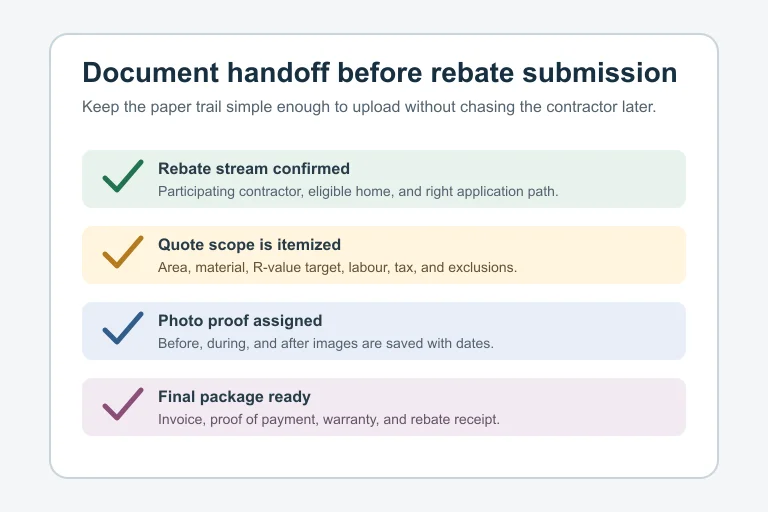
- Save the quote, invoice, warranty, photos, and program confirmations in one folder.
One careful quote conversation can prevent weeks of chasing documents. Ask the boring questions early, keep the answers in writing, and choose the contractor who makes the rebate file easier to prove.
Frequently Asked Questions
what questions should I ask an insulation contractor for Ontario rebates?
Ask which rebate stream applies, whether the contractor is participating, what area and R-value are included, who collects photos, how the invoice will be itemized, and what proof you will receive before final payment.
do I need a registered contractor for Ontario insulation rebate?
For the Home Renovation Savings insulation path, treat contractor participation as a must-verify item before signing. Ask the contractor to show where they are listed or how they are approved for the stream you plan to use.
should an insulation quote show R-value for a rebate?
Yes. The quote should state the existing condition when known, the target R-value, the insulation type, the area covered, and any exclusions that could affect eligibility or the final rebate amount.
can I pay the insulation contractor before rebate approval?
You can pay according to your contract, but do not make the final payment until you know what proof you will receive. Keep the invoice, payment record, photos, and any program confirmation together.
how many insulation quotes should I get before applying for a rebate?
Two or three comparable quotes are usually enough. The point is not just price. You want to compare scope, paperwork quality, payment terms, warranty language, and rebate support.
Official sources: Home Efficiency Rebate Plus | Ontario · Help and support. Check current program pages before applying.