Rebates
Canada Greener Homes Loan and Ontario Rebates in 2026: What Still Works
Canada Greener Homes Loan and Ontario rebates 2026 status: what is closed, what Ontario rebates remain, and how to plan upgrades.

Canada Greener Homes Loan and Ontario rebates 2026 searches usually come from homeowners trying to answer one practical question: can a retrofit still be funded, or did the main program close? The short answer is mixed. The federal loan is closed to new applications, while Ontario rebate streams can still matter if your home, upgrade, contractor, and paperwork fit the current rules.
Start with status, not wishful thinking. A closed federal program and an active provincial rebate are not the same thing, and mixing them up can lead to a bad contract, a missed pre-approval step, or a rebate you cannot actually claim.
| What you see | Likely cause | First move |
|---|---|---|
| A contractor says the federal loan is still open | Old sales script or confusion with existing approved files | Check the federal loan portal before signing |
| You already have a Canada Greener Homes Loan approval | Your file may continue under the existing loan process | Follow the portal instructions and deadlines |
| An Ontario rebate page lists your upgrade | The upgrade may be in an active Home Renovation Savings stream | Confirm the exact route before work begins |
| You need two or more upgrades | You may be looking at an assessment-based path | Book the required assessment first |
| A rebate promise sounds bigger than the official amount | Possible scam, outdated claim, or bundled financing pitch | Compare the offer with the official rebate page |
The 2026 status in plain English
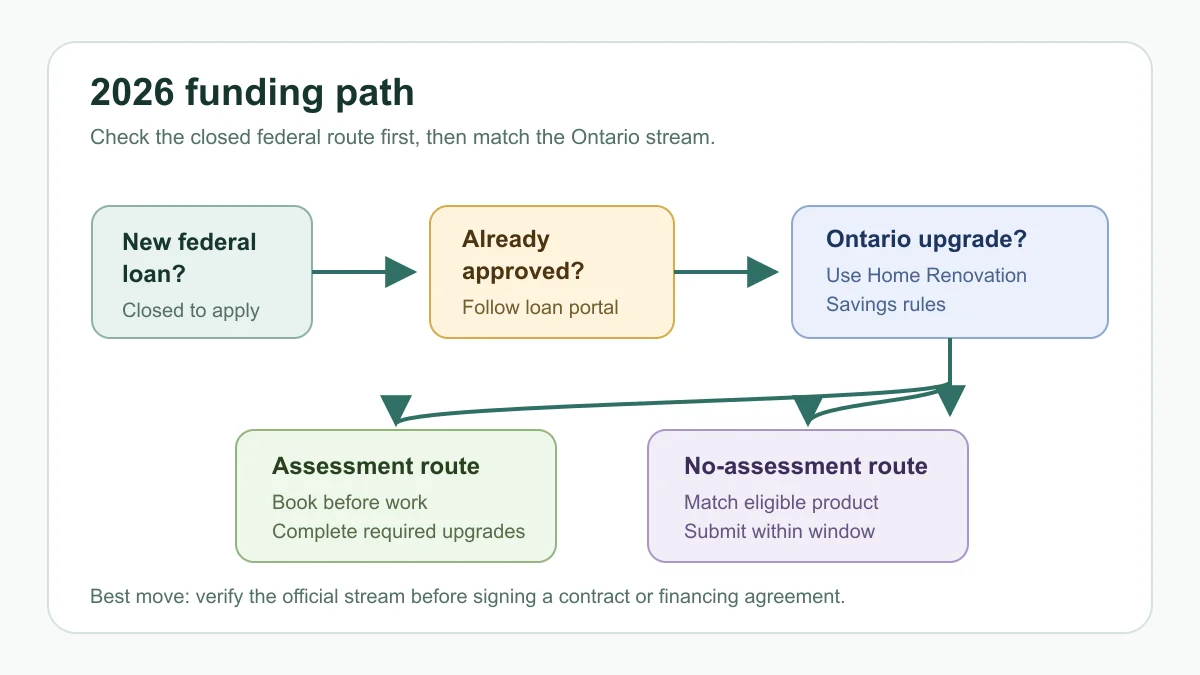
New Canada Greener Homes Loan applications are not the planning tool they were a year ago. The federal loan route has closed to new approvals, and the old grant stream has also closed for homeowners who did not already submit on time.
Approved loan files are different. If you were already approved, do not treat this article as a replacement for your portal instructions. Use your loan account, keep the documents requested, and avoid changing the project scope without checking the process.
Where Ontario rebates still fit
Ontario homeowners now need to think in streams. Home Renovation Savings can point you toward rebates for upgrades such as heat pumps, insulation, solar and storage, windows and doors, air sealing, smart thermostats, appliances, and heat pump water heaters, but the route depends on the measure.
Some upgrades sit in a no-assessment path. Others may require an initial home energy assessment, a registered energy advisor, recommended measures, and a follow-up step before the rebate is paid. That is why a quick check of whether Ontario home renovation rebates are worth it in 2026 is useful before you price the project.
Heat pumps are the big example. Before treating a quoted system as rebate-ready, compare the job against Ontario heat pump rebate income eligibility and the current fuel-source rules. A homeowner heated by Enbridge natural gas is not in the same situation as a homeowner heated by electricity, propane, oil, or wood.
Assessment route vs no-assessment route
Ask one question early: does this upgrade require an assessment before work starts? If yes, the order matters. Getting the installation done first can turn a good project into a rebate problem.
Assessment-based projects often demand a cleaner paper trail. Read up on energy advisor costs and rebates, then confirm whether your planned measures need the advisor visit, a custom report, and a follow-up assessment. For air sealing, the blower door test for air sealing rebates is not just a technical detail. It can be part of the claim logic.
No-assessment does not mean no rules. A smart thermostat, attic project, heat pump, solar install, or appliance replacement can still have product requirements, customer requirements, submission windows, and proof standards.
Planning by upgrade type
Solar and battery storage can still be attractive, but it is not a casual add-on. Check solar battery rebate preapproval before you order equipment, because capacity, cost caps, and bundle rules can change the math.
For insulation, the best rebate path depends on where the heat is leaking. Attic work often comes down to attic insulation R-value tiers, while exterior wall projects need a different read of the exterior wall insulation rebate rules. Basement work is its own category, especially if you need to confirm basement insulation assessment requirements.
Air sealing looks small on a quote, but it can affect comfort, draft complaints, and assessment results. If the basement is part of the scope, compare it with basement air sealing rebates before you accept a generic line item.
Windows and doors need careful counting. The $100 per opening window rebate guide explains why a “window” in everyday speech may not match the rebate calculation. You will also want the window and door rebate assessment rules and, once the job is quoted, a window rebate invoice checklist.
Water heating is easy to overlook. If you are replacing a tank, review the heat pump water heater assessment path before assuming the appliance alone qualifies.
How to protect the claim before you sign
Slow down when a salesperson bundles rebates, financing, and “today only” pressure into one conversation. Honestly, that is where most rebate mistakes start.
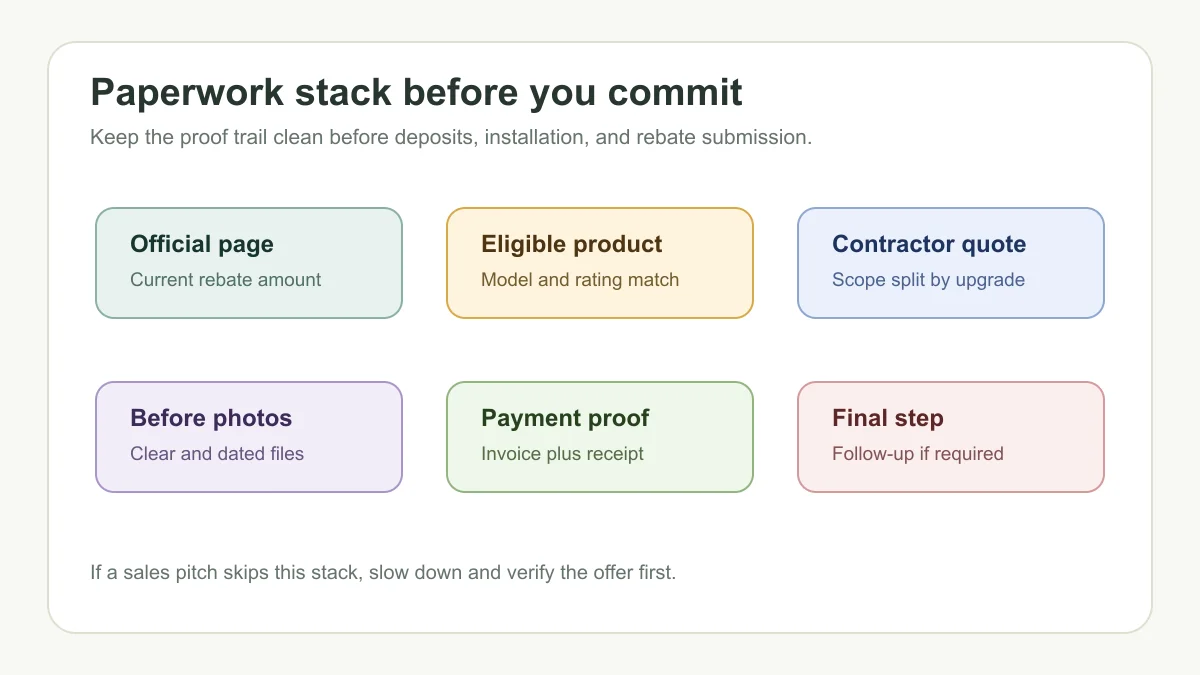
Use an official page, then build your quote around it. Ask the contractor the same questions covered in our contractor quote checklist and the more detailed insulation rebate quote questions if the project includes envelope work.
Keep the proof trail boring. That means before and after photo requirements, a clean proof of payment checklist, and invoices that match the program wording. If the project is already installed, track the rebate cheque status instead of repeatedly resubmitting partial information.
Watch for scams, too. A caller or door-knocker promising a special rebate outside the official site should be treated carefully, especially if the pitch conflicts with normal energy rebate scam invoice checks.
Best order of operations
- Confirm whether your project is federal-loan-related, Ontario-rebate-related, or both.
- If the federal loan was already approved, follow the loan portal and keep the scope aligned.
- Use the Home Renovation Savings application portal or official program pages to identify the right stream.
- Check whether an assessment is required before you start work.
- Get quotes that separate labour, equipment, and eligible measures.
- Save photos, product sheets, invoices, receipts, and advisor reports in one folder.
- Submit once the package is complete, then track status through the proper channel.
Quick Checklist
- Do not apply for a new Canada Greener Homes Loan in 2026 as if it were still open.
- If you already have an approved loan file, follow the portal instructions.
- Confirm the Ontario rebate stream before the contractor starts work.
- Check whether the upgrade needs an initial energy assessment.
- Match the product, fuel source, home type, and customer rules to the official page.
- Keep quote, invoice, receipt, photos, and application proof together.
- Reject rebate offers that do not match the official program wording.
Frequently Asked Questions
is Canada Greener Homes Loan still available in 2026?
No, not for new applications. The federal program is closed to new loan approvals, but already approved applications are a separate matter and should be managed through the loan portal.
can you combine Canada Greener Homes Loan with Ontario rebates?
Only if your loan file was already approved and the Ontario rebate rules also allow your specific project. Do not assume stacking is available just because both names appear in older search results.
what Ontario rebates are available in 2026?
Home Renovation Savings lists Ontario rebate opportunities for eligible upgrades such as heat pumps, insulation, windows and doors, solar and battery storage, air sealing, appliances, and smart thermostats. Availability depends on the stream and your home.
do Ontario rebates require an energy assessment?
Some do and some do not. Assessment-based paths usually require the visit before work starts, while no-assessment streams still require eligible products, proof, and timely submission.
should I wait for a new federal grant?
Waiting can make sense only if your project is optional and you can tolerate program uncertainty. If the upgrade is needed for comfort, safety, or equipment failure, price the Ontario rebate path that exists now and avoid betting the whole project on a future announcement.
Bottom line: treat 2026 as a verification year. The federal loan headline may be closed, but Ontario rebates can still lower the cost of the right upgrade when you follow the right path in the right order.
Official sources: Canada Greener Homes Initiative · Home Renovation Savings. Check current program pages before applying.