Rebates
Are Ontario Home Renovation Rebates Worth It in 2026?
Ontario home renovation rebates worth it 2026? Compare rebate amounts, assessment rules, paperwork risk, and after-rebate costs.

Ontario home renovation rebates worth it 2026 is a fair question because the answer is not just “yes” or “no.” A rebate can make a good insulation, window, air sealing, or water-heater project easier to afford, but it can also tempt you into work that was not your best next move.
Start with the house, then look at the rebate. If the project fixes drafts, cold rooms, moisture risk, high energy use, or equipment that is already due for replacement, the incentive can be useful. If the only reason to renovate is the cheque, slow down.
| What you see | Likely cause | First move |
|---|---|---|
| One room is cold all winter | Weak air sealing, attic gaps, or uneven insulation | Ask whether insulation or air sealing should come before windows |
| A contractor says “rebate guaranteed” | Sales pressure or missing eligibility detail | Check the official program page before signing |
| Your quote is much higher than expected | Scope creep, premium products, or bundled extras | Compare the after-rebate cost against a second quote |
| You want windows only | Program rules may require a minimum number of openings or another upgrade path | Confirm the current assessment and product rules first |
| You need comfort and lower bills | The best return may be hidden in insulation, air sealing, or controls | Prioritize the upgrade that fixes the biggest leak or loss |
Ontario home renovation rebates worth it 2026: the short answer
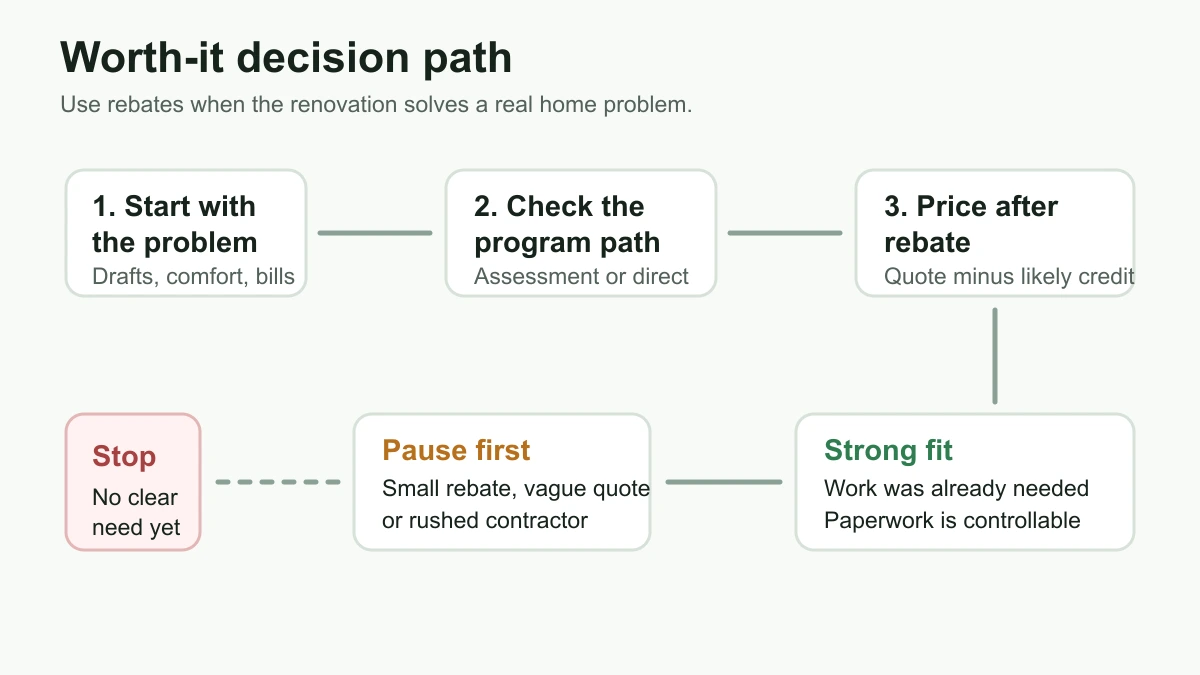
Yes, they can be worth it when the rebate supports a repair or efficiency upgrade you already needed. The current Home Renovation Savings program lists rebates such as insulation up to $7,700, windows and doors at $100 per rough opening, heat pump water heaters at $500, air sealing up to $250, and a home energy assessment rebate when the assessment path applies.
Those numbers matter, but they are not the whole decision. A $100 window rebate does not turn an overpriced window package into a bargain. A larger insulation rebate, on the other hand, can be meaningful if your attic, basement, exposed floor, or exterior walls are under-insulated and the work is properly scoped.
Where the value usually comes from
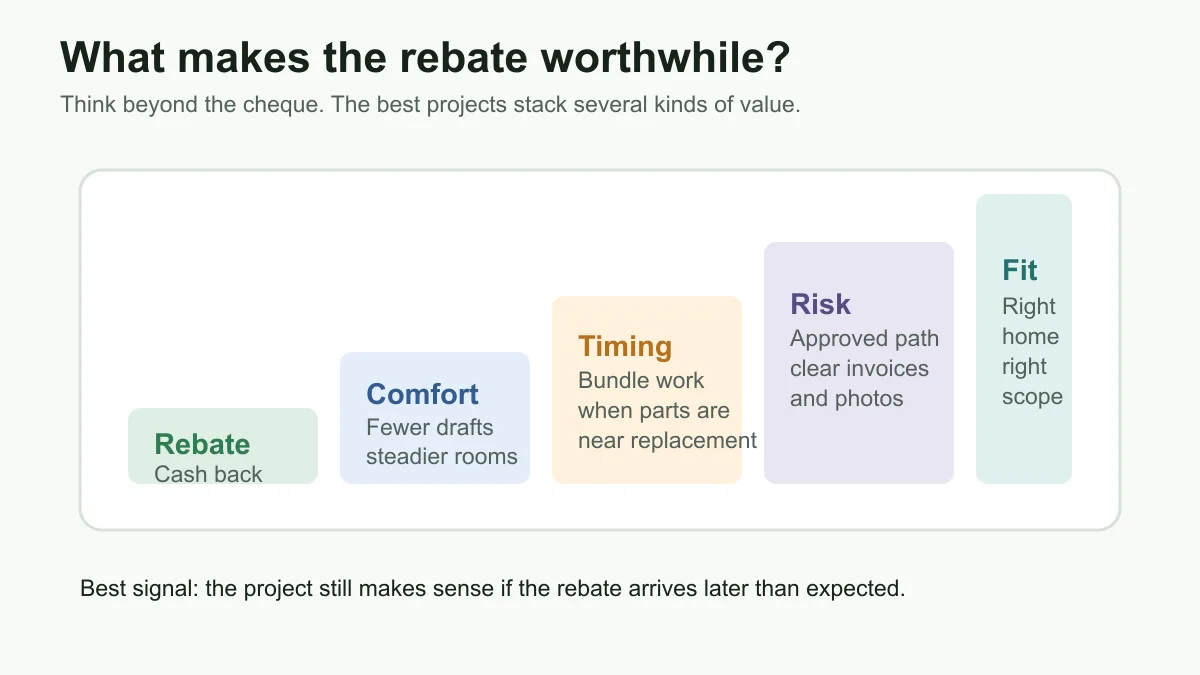
Look for stacked value. The rebate is one layer, but comfort, durability, energy savings, and good timing are often bigger than the cheque itself.
Insulation and air sealing tend to be strongest when you have clear comfort symptoms: drafts, ice-dam risk, chilly floors, or rooms that never hold temperature. Windows and doors can make sense when the units are failing, leaking, or already part of a planned renovation. Heat pump water heaters are more situational because space, noise, electrical setup, and existing fuel type matter.
Solar and battery rebates can be attractive too, but they need a different kind of math. If that is on your list, review the Ontario solar battery rebate preapproval steps before ordering equipment.
Projects that deserve extra caution
Be careful with any project where the contractor leads with the rebate before diagnosing the home. A good quote should explain the measure, the product, the eligible area or opening count, the paperwork, and what happens if the rebate is denied or delayed.
Windows are a good example. The program can be helpful, but the math changes fast if you replace more openings than needed just to qualify. Read how the $100 per opening window rebate works, then compare that with your real comfort or repair problem.
Insulation quotes need the same discipline. Ask what area is being upgraded, what R-value you start with, what R-value you will reach, whether air sealing is included, and how photos or invoices will be documented. The Ontario insulation rebate quote questions guide is useful before you sign.
Assessment path versus direct rebate path
Some upgrades may require a home energy assessment before work begins, especially when the program is asking you to complete multiple efficiency measures. Other offers can be more direct. That distinction is where people get tripped up.
Do not book work first and ask about the assessment later. If an assessment is required, starting early can protect your eligibility and help you decide whether to bundle upgrades. If you are trying to understand fees and reimbursement, compare your situation with Ontario energy advisor costs and rebates.
Heat pump water heaters are a good example of a project where the path matters. Before you choose a model, read the heat pump water heater assessment path and confirm whether your home, fuel type, and installation space fit the rules.
How to do the math without fooling yourself
Use a simple test. Would you still consider the project if the rebate arrived months later, or if the final approved amount was lower than expected? If yes, you are probably looking at a real upgrade. If no, the project may be too rebate-dependent.
Build your comparison around four numbers: the base quote, the eligible rebate, any assessment or paperwork cost, and the cost of doing nothing. “Doing nothing” is not always free. Cold rooms, moisture, poor comfort, and equipment failure can have their own price.
For households watching income-based program details, the Ontario heat pump rebate income eligibility explainer can help you separate equipment rules from household qualification rules.
Paperwork can decide whether the rebate feels worth it
Rebates are easier to value when the documentation is clean. Before-and-after photos, invoices, model numbers, payment proof, contractor details, and application timing can matter as much as the physical upgrade.
Plan that paperwork before the work starts. Use the before-and-after photo requirements, the payment proof checklist, and the Home Renovation Savings application portal guide as a pre-work checklist, not a last-minute scramble.
Also watch for bad sales behaviour. If a quote hides product details, pushes a deposit before eligibility is confirmed, or says official paperwork is “not your concern,” compare it with the Ontario energy rebate scam warning and the contractor quote checklist.
Which upgrade often makes the most sense?
No single upgrade wins for every home. Attic insulation can be a strong first move when the roof assembly is under-insulated, while basement or exterior wall work may matter more in older homes with cold lower levels or drafty envelopes.
Use the house symptoms to choose the category. For envelope work, compare attic insulation R-value tiers, exterior wall insulation rebates, basement insulation assessment rules, and basement air sealing rebates. If blower door testing is part of the plan, the air sealing blower door guide explains where it fits.
For windows and doors, check the assessment question early. The guide to window and door rebate assessment rules and the window rebate invoice checklist can save a lot of cleanup later.
Signs the rebate is probably worth pursuing
- The upgrade fixes a problem you can actually feel or measure.
- The contractor can explain eligibility without hand-waving.
- The product, model, R-value, opening count, or measure is written into the quote.
- You understand whether an energy assessment is required before work begins.
- The after-rebate price still compares well with other quotes.
- You can keep photos, invoices, payment records, and application proof organized.
If you are waiting on payment after an approved project, use the rebate cheque status guide rather than relying on a contractor’s timeline.
Quick Checklist
- Confirm the current official rebate page before signing a quote.
- Decide whether the work solves comfort, durability, energy, or equipment timing.
- Ask whether a home energy assessment is required before any work starts.
- Get the eligible measure, product details, and quantities in writing.
- Compare total quote, after-rebate cost, and a second quote.
- Plan photos, invoices, payment proof, and application records before installation.
- Use caution if a contractor promises approval without checking your home.
Official sources: Home Renovation Savings · Save on Energy Home Renovation Savings. Check current program pages before applying.
Frequently Asked Questions
Are Ontario home renovation rebates worth it in 2026?
They are worth it when the project was already needed and the rebate reduces a sensible after-rebate cost. They are less convincing when the project is oversized, rushed, or mainly sold around the incentive.
What Ontario renovation rebates give the most money back?
Insulation can offer the largest listed rebate amount, but the best value depends on your home. A smaller rebate on a necessary repair can beat a larger rebate attached to work you did not need.
Do I need an energy assessment for Ontario renovation rebates?
Some upgrades require an assessment before work begins, especially assessment-path measures such as insulation, windows and doors, air sealing, and heat pump water heaters. Always confirm the path before booking installation.
Are window rebates in Ontario worth it?
Window rebates can help when the windows are failing or already scheduled for replacement. They rarely justify replacing sound windows just to collect a per-opening rebate.
How do I avoid losing my Ontario home renovation rebate?
Start with official eligibility rules, use a participating or properly documented contractor where required, keep photos and invoices, and do not begin assessment-path work before the required assessment.
Bottom line: Ontario renovation rebates are worth pursuing when they support the right project at the right time. Let the home’s real problems lead the decision, then use the incentive to lower the cost, not to justify work that does not stand on its own.