Solar
Ontario Solar Battery Rebate Preapproval in 2026: What to Do Before You Buy
Ontario solar battery storage rebate preapproval 2026 steps, documents, timing, and red flags before you buy solar or batteries.
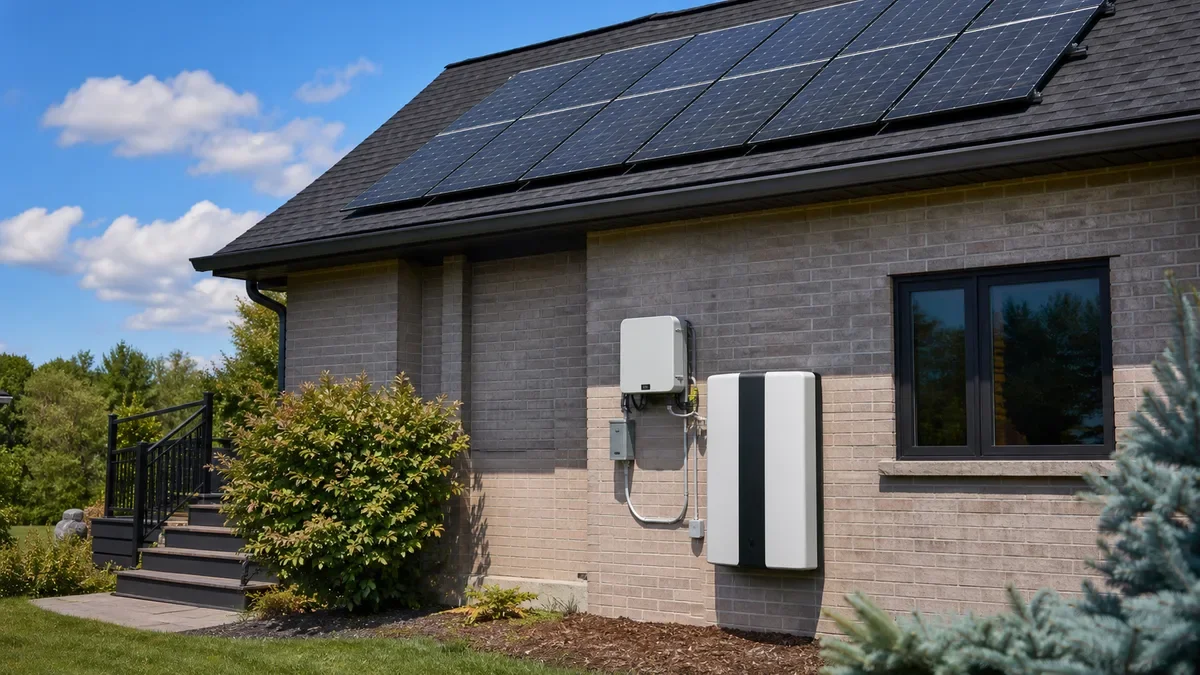
Ontario solar battery storage rebate preapproval 2026 is really about timing: the rebate file has to be approved before you buy equipment or let the installation begin. If you are planning rooftop solar with a paired battery, treat the preapproval step as part of the project design, not a formality at the end.
For Ontario homeowners, the Home Renovation Savings solar and storage stream can be valuable, but it is also paperwork-heavy. The fastest path is to make your quote, utility connection plan, contractor role, and ownership details line up before anyone orders hardware.
| What you see | Likely cause | First move |
|---|---|---|
| A contractor says the rebate can be handled after installation | The pre-installation rule is being skipped | Ask for the written preapproval workflow before signing |
| The quote lists panels but not battery capacity | The file may not show the kWh being claimed | Request a revised quote with system size and storage size |
| Your utility has not reviewed the connection | LDC approval is still unresolved | Have the contractor explain the local connection application |
| You already have solar or storage equipment | The project may fail the first-time installation rule | Confirm eligibility before paying a deposit |
| The contractor pushes a net metering design | The rebate stream is for load displacement, not net metering | Ask how the design stays within program rules |
Ontario solar battery storage rebate preapproval 2026: the part not to skip
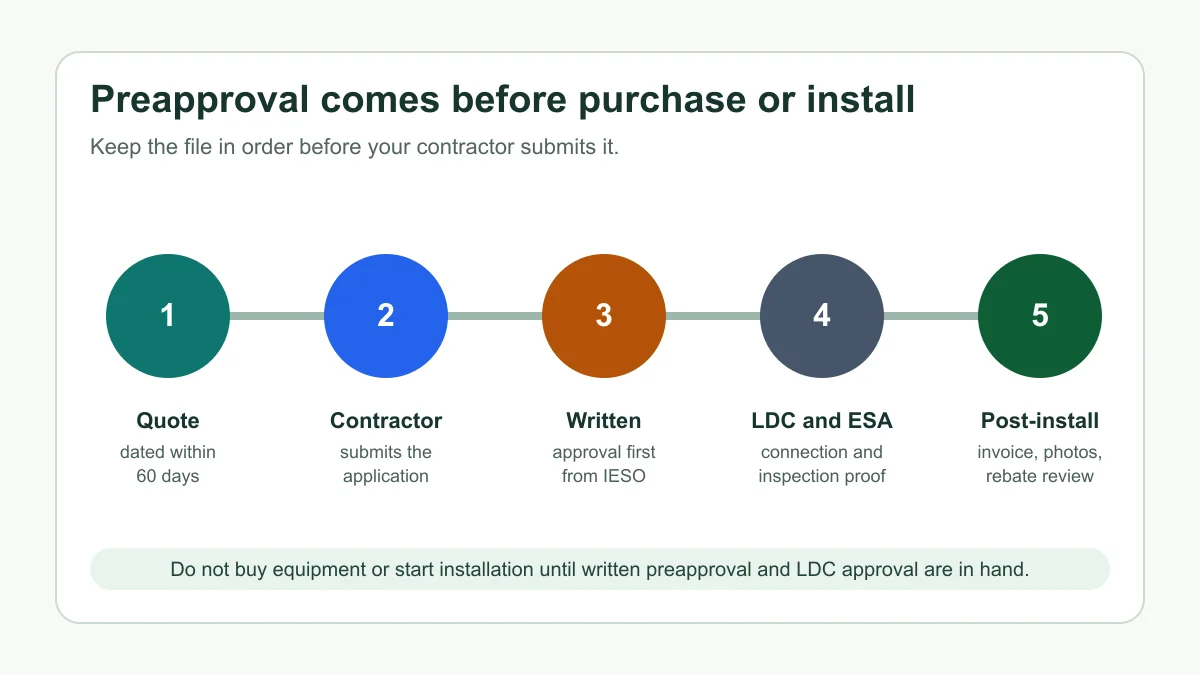
The official solar and storage stream is built around a pre-installation application. Your contractor submits it on your behalf, and the file needs written preapproval from the IESO plus approval from your local distribution company before the eligible measures are purchased or installed.
That order matters. Buying the battery first, starting roof work early, or treating LDC approval as a later step can put the rebate at risk even if the equipment itself looks eligible.
How much the solar and battery stream can cover
Home Renovation Savings lists solar and battery storage as a no-assessment path with up to $10,000 available when the project qualifies. The stream requirements break that into two caps: solar PV can be $1,000 per kW DC up to $5,000, and paired battery storage can be $300 per kWh up to $5,000.
Those maximums are also capped by eligible costs, so do not assume every system gets the headline number. A small system, a smaller battery, excluded costs, HST, financing costs, or duplicate funding can all reduce what the file supports.
What has to be ready before the contractor submits
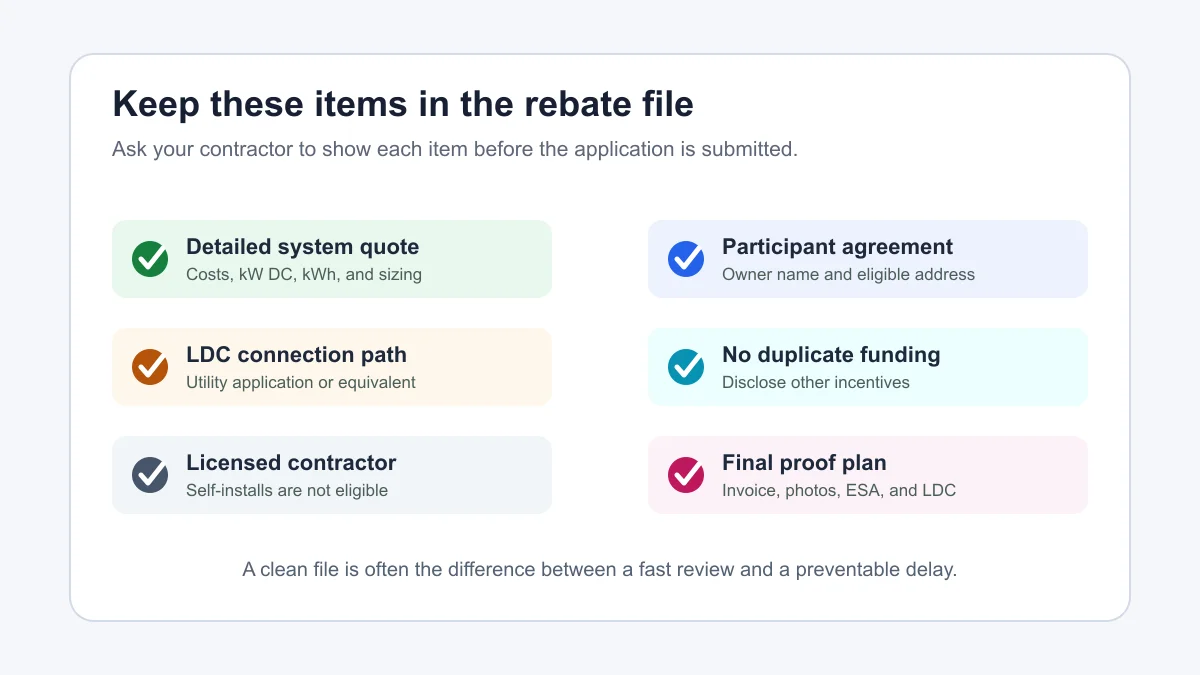
Start with a detailed quote that is current. The stream requirements call for a system quote dated within 60 days of the pre-installation application, along with project rationale, sizing, the homeowner name, the eligible home address, the LDC name, proposed solar capacity in kW DC, and battery capacity in kWh when storage is included.
The contractor may also need a single-line diagram or system sketch if the LDC requires it. You should expect the file to disclose other funding sources and include a signed participant agreement.
Eligibility checks that can stop a project early
The home needs a residential hydro metered account and a connection to the IESO-controlled grid through an Ontario LDC, excluding Cornwall Electric. The eligible residence types include single detached, semi-detached, row house, townhome, or a mobile home on a permanent foundation.
First-time installation is a major filter. The residence must not already have an existing solar or storage system for the eligible measure being claimed.
Solar PV also has to be rooftop-mounted on the eligible home or a permanent existing structure on the property, such as a detached garage, and connected to the hydro meter serving the home. Ground-mounted systems, portable structures, recreational vehicles, and trailers are not the right fit for this stream.
Battery rules are stricter than many homeowners expect
The battery is not a standalone rebate in this stream. It has to be paired with a new solar system and sized appropriately for that solar PV system.
Installation has to be done by a licensed electrical contractor. Self-installations are not eligible, and the finished system needs to satisfy electrical, fire code, certification, LDC, and ESA requirements.
One detail deserves extra attention: the system must be sized for load displacement only. Systems subject to a net metering agreement are not eligible for this rebate, so make sure the contractor is not mixing two different project models in the same sales pitch.
The timeline after preapproval
Once the pre-installation file is approved, the project still has to be completed within the program window. The stream requirements say eligible measures must be completed within 12 months after the date of pre-installation approval.
After installation, the contractor submits the post-installation application. That file usually includes the itemized final invoice, photos of the installed measures, the LDC generation connection agreement, ESA certificate or inspection report, and any additional documents requested by the program team.
Build that post-installation package into your project plan from the start. You do not want to be chasing nameplate photos or proof of payment after the installer has moved on to the next job.
Questions to ask before you sign a solar quote
Ask whether the quoted solar size is in kW DC and whether the battery size is listed in kWh. Then ask who submits the pre-installation application, who handles the LDC connection application, and what document you will receive when written preapproval is granted.
Push for plain answers about excluded costs too. HST, financing costs, insurance, repair work, spare equipment, and tool purchases are not treated the same way as eligible equipment, approvals, permits, and labour.
Need a broader contractor screen? Compare the solar quote process with our Ontario rebate contractor quote checklist, then use the Home Renovation Savings proof of payment checklist before the final invoice is issued.
Where this fits with other Ontario rebate work
Solar and storage may not require a home energy assessment, but other upgrades can. If you are bundling work across the house, map the paths separately so one contractor does not confuse the rules for another stream.
For example, window projects have their own $100 per opening rebate rules and a separate contractor invoice checklist. Some insulation work may involve quote checks, R-value targets, or assessment questions, such as insulation quote questions, attic insulation R-value tiers, exterior wall insulation rebates, basement insulation assessment rules, and basement air sealing rebates.
Heat pump files can also run on a different approval path. Use the Ontario heat pump income eligibility guide, the heat pump water heater assessment path, the heat pump pre-approval checklist, and the propane to heat pump rebate checks if your broader retrofit includes space or water heating.
Rebate paperwork habits that prevent delays
Keep one folder for the quote, signed agreement, utility paperwork, permits, ESA documents, invoice, payment proof, and final photos. If the contractor uses a portal, ask for copies of what was submitted so you are not relying on memory later.
Be cautious with anyone who asks for personal details through an unverified website or says they are the only way to access rebates. Home Renovation Savings warns homeowners about fake sites, unauthorized offers, and contractor impersonation, so use the official program site and known contractor contacts.
For adjacent paperwork, bookmark the Home Renovation Savings application portal guide, rebate cheque status checks, rebate photo requirements, contractor invoice scam checks, energy advisor cost expectations, window and door assessment rules, and the air sealing blower door test explainer.
Quick Checklist
- Confirm the home is eligible and does not already have solar or storage equipment.
- Get a detailed quote dated within 60 days of the pre-installation application.
- Make sure solar capacity, battery capacity, LDC name, and project sizing are clear.
- Do not buy equipment or start installation before written preapproval and LDC approval.
- Ask how the design avoids net metering if the rebate stream requires load displacement.
- Keep copies of the participant agreement, utility documents, ESA proof, photos, and invoice.
- Plan the post-installation submission before the contractor leaves the site.
Bottom line
The solar and battery rebate can be meaningful, but the real decision point comes before the panels are installed. Get the quote, contractor submission, LDC path, and written preapproval lined up first, then treat the installation as the second half of the rebate file.
Frequently Asked Questions
do I need preapproval for Ontario solar battery rebate 2026?
Yes. The solar and storage stream requires the contractor to submit a pre-installation application, and the homeowner must receive written preapproval plus LDC approval before eligible measures are purchased or installed.
how much is the Ontario solar battery storage rebate in 2026?
The stream can provide up to $5,000 for eligible solar PV and up to $5,000 for paired battery storage, with each amount also capped by eligible costs and the system size rules.
can I install the battery first and apply later?
No. Installing or purchasing before written preapproval can make the measure ineligible. The battery also has to be paired with a new eligible solar PV system under this stream.
does the Ontario solar rebate allow net metering?
The stream requirements say systems subject to a net metering agreement are not eligible. Ask your contractor and LDC how the proposed design fits the program before you submit.
who submits the Home Renovation Savings solar application?
The contractor selected by the participant submits the application and uploads the required documents on the homeowner's behalf. You should still keep copies of every document in the file.
Official sources: Solar and Storage Program Stream Requirements · Home Renovation Savings Program. Check current program pages before applying.