Solar
Ontario Solar Rebates in 2026: The Net Metering Tradeoff
solar rebate Ontario net metering not permitted 2026: learn the HRS load-displacement rule before choosing a solar quote.

solar rebate Ontario net metering not permitted 2026 is a very specific search because the rule changes the whole solar calculation. If you are looking at Ontario's Home Renovation Savings solar stream, do not treat the rebate as a normal net-metering incentive. The program is aimed at load displacement, which means the system is supposed to serve your own home rather than earn credits from exported power.
That does not make the rebate useless. It does mean the quote has to be sized differently, and the contractor should explain the tradeoff before you sign.
| What you see | Likely cause | First move |
|---|---|---|
| Contractor mentions a rebate and net metering together | Two different value paths may be getting blended | Ask which path the proposal is actually using |
| Large array sized to annual usage | The quote may assume export credits | Request load-displacement sizing based on daytime use |
| Battery storage is included | The installer may be trying to capture daytime excess | Ask for expected battery cycling and usable capacity |
| Utility approval is missing | Connection review has not been completed | Contact the LDC before equipment is ordered |
| Rebate savings look bigger than operating savings | The project may depend too heavily on the incentive | Model the system with and without the rebate |
solar rebate Ontario net metering not permitted 2026: the rule in plain English
Home Renovation Savings lists rooftop solar panels at up to $5,000 back, with a separate battery storage rebate also up to $5,000. The catch is not buried in fine print: participants who receive the solar PV or battery incentive are not eligible to participate in a net-metering agreement with their local distribution company for that participating project.
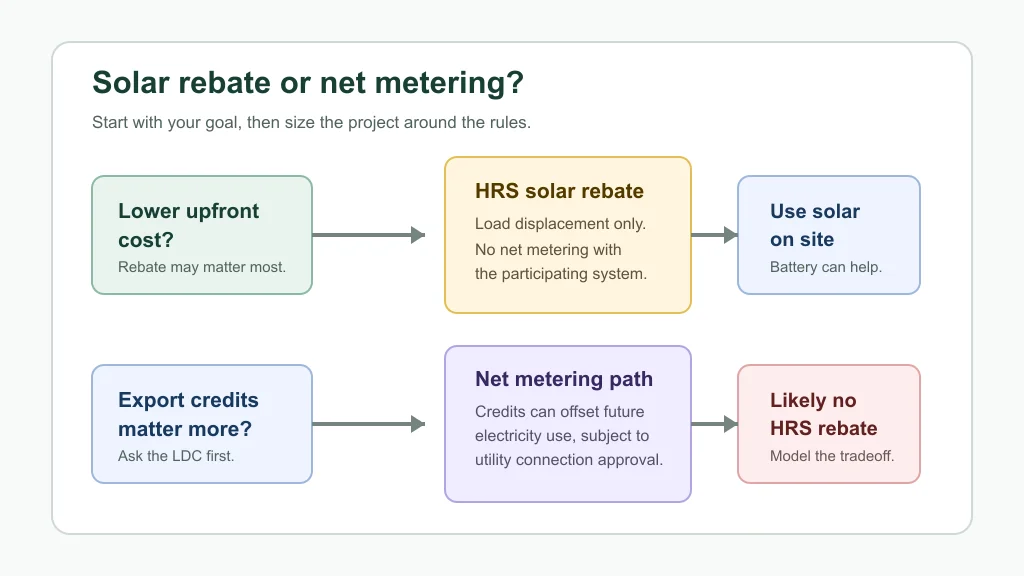
Read that as a fork in the road. One route is a rebate-funded, load-displacement system designed to cover your own household demand. The other route is a net-metered system where excess generation can flow to the grid for bill credits under Ontario's net-metering framework.
Why the rule changes the solar math
Net metering usually rewards a system for producing more than the home can use at certain times of day. The utility measures power flowing in both directions and provides credits for eligible exported electricity. Without that export-credit path, the best rebate design usually gets tighter: smaller array, more attention to daytime loads, and possibly a battery sized around self-consumption.
Honestly, this is where many simple payback estimates get shaky. A solar system that looks strong under net metering can look weaker when export value disappears. A smaller system that looks modest on paper may fit the rebate stream better because more of its output is used inside the home.
If you are already comparing other efficiency upgrades, read the Home Renovation Savings Program guide and the assessment versus no-assessment comparison. Solar and battery storage are no-assessment upgrades, while several envelope and mechanical upgrades follow a different process.
How to decide between the rebate path and net metering
Start with your actual electricity use. Look at monthly bills, time-of-use habits, summer air-conditioning loads, electric vehicle charging, hot tub use, and whether anyone is home during the day. The more energy you can use while the panels are producing, the more sense a load-displacement design can make.
Then ask what you would lose by giving up net metering. Ontario's net-metering rules can let eligible customers receive bill credits for exported renewable electricity, but those credits are not the same as cash and they come with rules. Your local utility still has to confirm connection details, technical requirements, and eligibility.
Use the flow below as a gut check: if the upfront rebate is the main reason the project works, the HRS route may be worth modelling. If exported power credits are central to the economics, the net-metering path deserves a separate quote.
Battery storage can help, but it is not magic
Pairing a battery with solar can improve self-consumption because daytime generation can be stored for evening use. It can also add resilience during outages, depending on the equipment and how the backup circuits are configured. Those benefits are real, but they are not free.
Ask for usable kilowatt-hours, expected daily cycling, warranty terms, backup capability, and whether the battery is being charged mainly from the solar PV system. Home Renovation Savings says battery storage systems must be paired with a new rooftop solar PV system and should be designed primarily around solar generation rather than grid charging.
For more context on that stream, see our solar battery storage rebate guide. If your home is also adding load through transportation, compare the EV charger installation cost guide before sizing solar around future electricity use.
What your contractor should show you
A serious proposal should not simply say "rebate eligible." It should show the system size, expected annual production, daytime self-use assumptions, battery capacity if included, local utility connection steps, and the documents required before installation starts.
Watch for one subtle issue: a contractor may be comfortable selling net-metered solar and less familiar with a no-export or limited-export rebate design. That does not make the contractor bad, but it does mean you should ask sharper questions.
If you are still choosing an installer, use the participating contractors planning guide to frame the conversation before a sales quote becomes a contract.
- Which path is this quote using: rebate load displacement or net metering?
- How was the solar PV size chosen from my actual energy use?
- Will the design export electricity to the grid under normal operation?
- What does the LDC need before connection approval?
- Which equipment models, warranties, and standards support the rebate file?
- What happens if the program rejects part of the claim?
Other upgrades to compare before committing
Solar is only one way to cut household energy costs. If your budget is limited, compare the solar quote against building-envelope work and mechanical upgrades. A drafty house may get better comfort from air sealing, attic insulation, foundation insulation, exposed floor insulation, flat roof insulation, or cathedral ceiling insulation before panels go on the roof.
Windows and controls can also change the load profile. These guides cover the Ontario window rebate, the 3-windows-or-1-door rule, what a rough opening means, and the smart thermostat rebate. If you are still mapping the full house plan, the Ontario insulation rebate guide is a useful next stop.
Heat pumps and water heating are worth a separate look because they can increase electricity use while reducing fuel use. Compare the heat pump cost and rebate math, the Enbridge heat pump rebate guide, and the heat pump water heater rebate. If financing is part of the plan, check the Canada Greener Homes Loan status before assuming new applications are open.
Quick Checklist
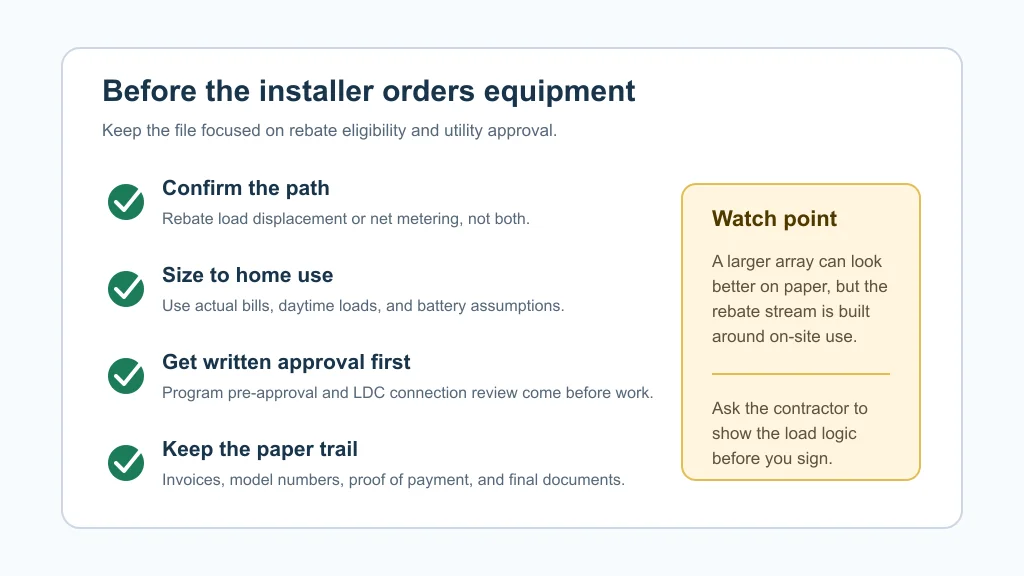
- Confirm whether you want the HRS rebate path or a net-metering path.
- Ask the contractor to size the system for on-site use if you choose the rebate.
- Get local distribution company connection requirements before equipment is ordered.
- Review whether battery storage improves self-consumption enough to justify the cost.
- Keep product model numbers, invoices, proof of payment, and approval documents together.
- Compare solar against insulation, air sealing, heat pumps, and other rebate-supported work.
- Check current official program pages before relying on any quote or rebate amount.
Bottom line
Ontario homeowners can still look at solar in 2026, but the Home Renovation Savings rebate is not a standard net-metering subsidy. Treat the rebate and net metering as competing paths, model both, and make the contractor show the assumptions. A clean quote should make the choice easier, not blur it.
Frequently Asked Questions
can I get the Ontario solar rebate and net metering in 2026
For the Home Renovation Savings solar and storage stream, the answer is generally no. The program says participating solar PV and battery projects are not eligible to participate in a net-metering agreement with the local distribution company.
what does load displacement mean for Ontario solar rebates
Load displacement means the solar system is designed to serve the home first, instead of being sized around exporting excess electricity for bill credits. In plain terms, the rebate path rewards reducing grid demand at your own house.
is Ontario net metering still available for solar
Yes, Ontario net metering still exists, but it is a separate path from this rebate stream. You still need to check eligibility, connection rules, and technical requirements with your local utility before investing.
does a battery help if net metering is not permitted
A battery can help by storing excess daytime solar for evening use or outages, but it changes the budget. Ask the contractor to show how much energy the battery is expected to shift, not just the rebate amount.
should I choose the solar rebate or net metering
Choose based on your load profile, roof size, available budget, and how much exported power would matter. For some homes, the upfront rebate is the better fit. For others, a net-metered system may be worth more over time.
Official sources: Home Renovation Savings solar rebates · Ontario Energy Board net metering. Check current program pages before applying.