Insulation
foundation insulation rebate Ontario basement wall 2026
foundation insulation rebate Ontario basement wall 2026: HRS rebate amounts, R-value tiers, assessment steps, and checks before work starts.
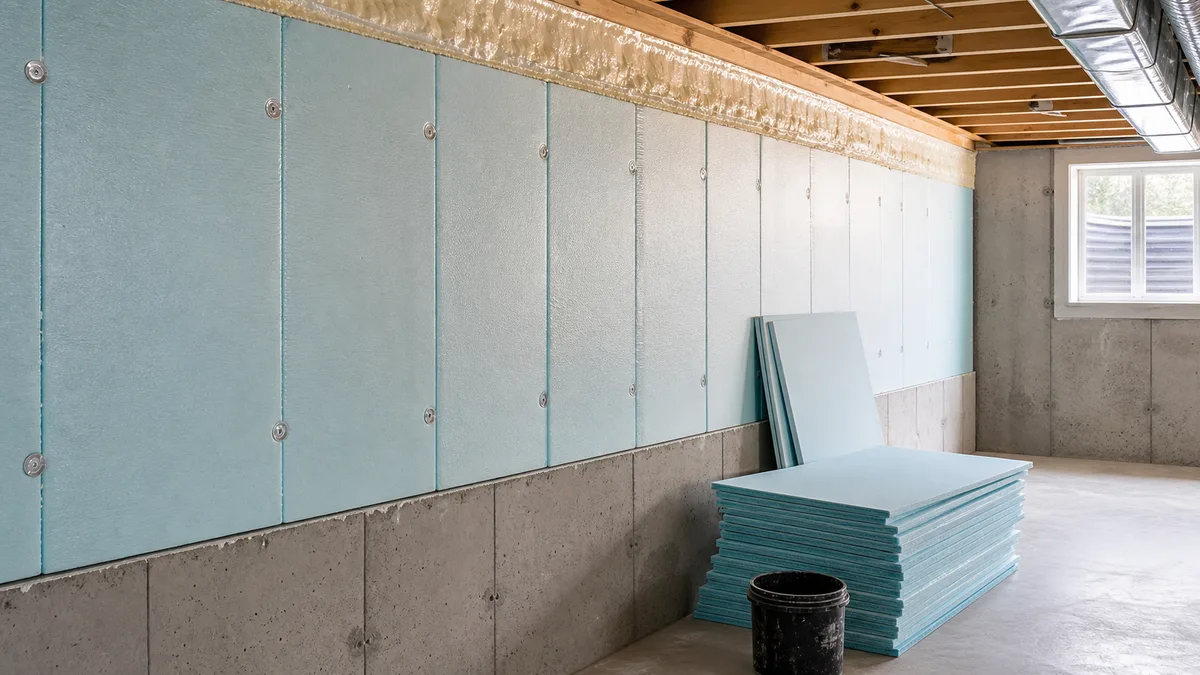
If you are searching for foundation insulation rebate Ontario basement wall 2026, the rebate can look simple at first: insulate the basement walls, submit the paperwork, get money back. The real decision is whether your home, assessment path, wall area, R-value target, and contractor documentation line up before the basement gets covered.
Start with the program sequence, not the insulation product. Basement wall work is hard to verify after drywall goes up, so the boring paperwork step is what protects the rebate.
| What you see | Likely cause | First move |
|---|---|---|
| Bare concrete basement walls | No continuous foundation insulation | Book the initial energy assessment before work starts |
| Cold rim joist and drafty sill area | Header area and air leakage are being missed | Ask whether header insulation is part of the basement scope |
| Damp wall, efflorescence, or musty smell | Moisture may be entering before insulation | Fix water management before trapping the wall behind finishes |
| Quote lists only part of the basement | Project may not meet the full wall-area condition | Confirm the measured basement wall area and covered percentage |
| Contractor promises a rebate without an assessment | Wrong rebate stream may be assumed | Compare the quote with the HRS assessment path first |
Basement wall rebate amounts for 2026
Home Renovation Savings currently lists foundation insulation under the upgrades that need a home energy assessment. The headline amount is up to $2,300 for the broader foundation insulation category, but basement wall insulation has its own tiers.
For basement walls, the public HRS page shows $1,500 when you add insulation value greater than R-22 to 100% of the basement wall area. It shows $900 when you add R-10 to R-22 to 100% of the basement wall area.
| Basement wall upgrade | Coverage condition | Listed rebate |
|---|---|---|
| Add greater than R-22 | 100% of basement wall area | $1,500 |
| Add R-10 to R-22 | 100% of basement wall area | $900 |
Why the assessment path matters
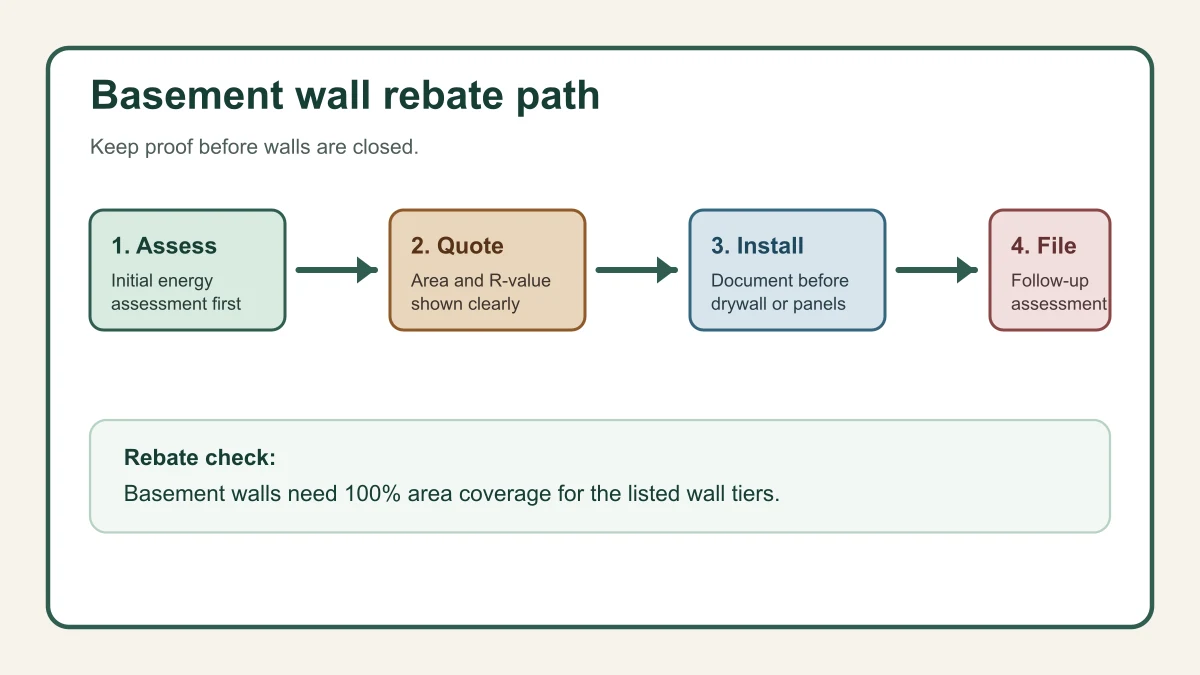
Foundation insulation sits on the assessment-required side of HRS. That means the safer order is initial assessment, Renovation Upgrade Report, contractor quote, installation, follow-up assessment, then rebate submission.
That order matters because basement insulation is easy to hide behind framing and finishes. Once the wall is closed, proving area, insulation value, and installation details becomes much harder.
Need help deciding whether this is the right program route? Compare the assessment-required path with no-assessment upgrades in the Ontario Home Renovation Savings assessment vs no assessment 2026 comparison, then use the broader Home Renovation Savings Program Ontario 2026 guide to understand how the streams fit together.
Check eligibility before choosing insulation
Start with the homeowner rules. HRS says you must own the home, and eligible housing types include single detached homes, semi-detached homes, row or townhomes, and mobile homes on a permanent foundation.
Heating and utility details also matter. The program describes eligibility for Enbridge Gas customers who primarily heat with a natural gas furnace or boiler, and for homes connected to Ontario's electricity grid that heat with electricity, propane, oil, or wood, with a specific Cornwall Electric caveat.
Book the right people early. The Home Renovation Savings participating contractors Ontario 2026 guide explains how to avoid relying on a contractor who is not aligned with the program process.
What counts as basement wall work
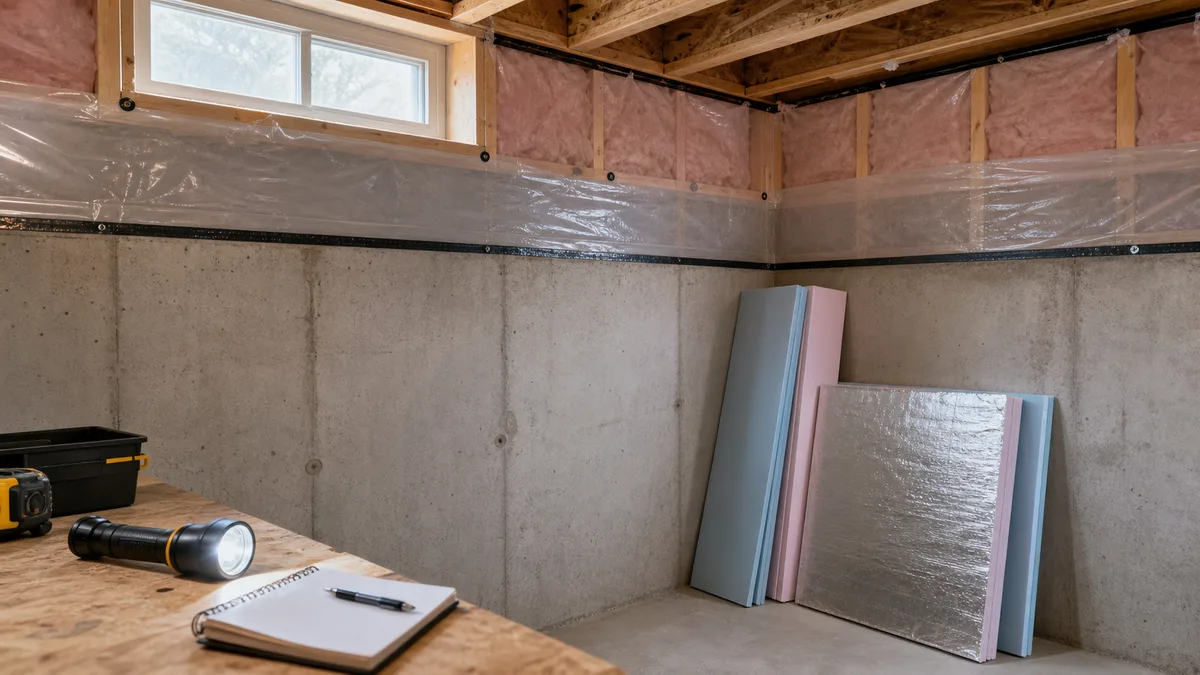
Basement wall insulation usually means adding insulation to the interior side of the foundation wall, or using another assembly that the advisor and contractor can document. The rebate language focuses on added insulation value and the full basement wall area, not just comfort in one room.
Ask for the quote to show the starting condition, the proposed R-value, the total wall area, the percentage being insulated, and whether the rim joist or foundation header area is included. Header insulation has its own rule: HRS says it does not qualify as a standalone qualified measure, but it may qualify when done with crawl space wall insulation or basement wall insulation.
Moisture, air sealing, and sequencing
Basement insulation can make a home more comfortable, but it can also hide a water problem. If the wall has active leaks, bulk water entry, damp corners, or a grading issue outside, solve that first.
Air leakage matters too. Rim joists, penetrations, sill plates, and service openings can leave the basement cold even after wall insulation is added. For that part of the project, the air sealing rebate Ontario airtightness target 2026 guide is worth reading before you finalize the scope.
Think in assemblies, not products. A rigid board, batt, spray foam, or hybrid wall can all fail if moisture control, vapour control, fire protection, and code details are treated as afterthoughts.
How basement walls compare with other insulation rebates
Basement wall insulation is not the only envelope upgrade under HRS. Attics, cathedral ceilings, flat roofs, exterior walls, exposed floors, crawl spaces, and air sealing can all affect comfort and eligibility in different ways.
If the basement is not the biggest heat-loss issue in your home, compare it with the attic insulation R-12 to R-50 2026 guide, the flat roof insulation rebate Ontario 2026 guide, and the cathedral ceiling insulation rebate Ontario 2026 guide. The full insulation rebate Ontario 2026 guide can help you compare attic, basement, wall, and air sealing options together.
Bundle planning without chasing every rebate
The assessment path generally requires at least two energy-saving upgrades, and HRS promotes an extra $500 when you complete three qualifying upgrades. That can be useful, but only if the extra work fits the house.
Windows, heat pump water heaters, heat pumps, smart thermostats, solar, and EV charging can all enter the planning conversation, depending on your home. Use the window rebate Ontario 2026 guide, heat pump water heater rebate Ontario 2026 guide, and heat pump cost Ontario 2026 rebate math guide when you are comparing budget impact.
Gas customers may also want the Enbridge heat pump rebate Ontario 2026 guide. If your home may qualify for no-assessment heat pump support, compare the Ontario heat pump rebate program 2026 guide with the Ontario heat pump rebate with no energy assessment 2026 guide.
Documents to keep before walls are closed
Make a simple project folder before the first contractor visit. Put the initial assessment report, Renovation Upgrade Report, contractor quote, product data sheets, permits if needed, before-and-after photos, invoices, payment proof, and follow-up assessment paperwork in one place.
Ask the contractor to write the insulation value and coverage percentage clearly. A vague line like "insulate basement" is not enough when the rebate depends on R-value and 100% wall-area coverage.
Budget planning can also include financing context. The Canada Greener Homes Loan 2026 update explains why homeowners should not assume that older federal loan pathways are still open for new applications.
Other upgrades to coordinate around the basement
Basement work can affect future mechanical, electrical, and solar plans. If the wall is open, it is a good time to think about wire paths, panel capacity, and equipment space, even if those upgrades happen later.
For adjacent planning, see the EV charger installation cost Canada 2026 guide, the smart thermostat rebate Ontario 2026 guide, and the solar battery storage rebate Ontario 2026 guide. Those topics are not substitutes for basement insulation, but they can change the order of renovations.
Quick Checklist
- Confirm you own an eligible Ontario home type before spending money on quotes.
- Book the initial home energy assessment before any basement insulation work begins.
- Ask the advisor where basement wall insulation appears in the Renovation Upgrade Report.
- Get the quote to show total basement wall area, coverage percentage, and target R-value.
- Fix water entry, drainage, and damp wall problems before insulation is installed.
- Photograph the open walls, installed insulation, rim joist details, and product labels.
- Keep invoices, reports, emails, and follow-up assessment documents until the rebate is paid.
Bottom line
Basement wall insulation can be a strong comfort upgrade, especially in older Ontario homes with bare concrete foundations. The rebate side is less forgiving: follow the assessment path, document the full wall area, choose the R-value tier honestly, and do not cover the work before you have proof.
Frequently Asked Questions
how much is the basement wall insulation rebate in Ontario 2026?
The current Home Renovation Savings assessment path lists $1,500 when basement wall insulation adds more than R-22 to 100% of the basement wall area, or $900 when it adds R-10 to R-22 to 100% of the basement wall area.
does foundation insulation need a home energy assessment in Ontario?
Yes for the Home Renovation Savings foundation insulation stream. The public program page says the bundle path starts with an initial home energy assessment and requires a follow-up assessment after the upgrades are complete.
can I get a rebate for insulating only part of my basement walls?
Do not count on it. The basement wall tiers refer to 100% of the basement wall area, so partial work can create eligibility problems unless the program terms or your energy advisor confirm otherwise in writing.
does foundation header insulation qualify by itself?
No, not as its own qualified measure. HRS says foundation header insulation may qualify for a rebate when it is done with crawl space wall insulation or basement wall insulation.
can I start basement insulation before the assessment?
That is risky. For the assessment-required path, schedule the initial assessment before beginning work, then use the Renovation Upgrade Report and program instructions to plan the job.
Official sources: Energy assessment required upgrades · Home Efficiency Rebate Plus. Check current program pages before applying.