Insulation
Attic Insulation Rebate Ontario R-12 to R-50 2026: How to Claim It Without Losing Eligibility
Attic insulation rebate Ontario R-12 to R-50 2026: check HRS amounts, eligibility, contractor steps, and timing before you insulate.
Attic Insulation Rebate Ontario R-12 to R-50 2026: How to Claim It Without Losing Eligibility
Attic insulation rebate Ontario R-12 to R-50 2026 is a very specific search because the starting R-value changes the rebate amount. As of June 7, 2026, the Home Renovation Savings attic stream lists a no-assessment route for attic-only work, while the assessment route can pay more when attic insulation is part of a qualifying multi-upgrade file.
Start by treating this as a paperwork sequence, not just an insulation quote. In my experience, homeowners lose time when they insulate first and ask about the rebate after the attic is already topped up.
| What you see | Likely cause | First move |
|---|---|---|
| Your attic is around R-12 or lower | Older insulation depth, settling, or missing coverage | Document the current level before any work starts |
| A quote says "rebate eligible" but no route is named | The contractor may be mixing assessment and no-assessment rules | Ask which Home Renovation Savings path applies |
| You want only attic insulation | The no-assessment attic path may fit | Use the official intake process and participating insulation contractor list |
| You plan windows, air sealing, or water heating too | The assessment bundle may be better | Confirm whether a pre- and post-assessment is required |
| Work has already started | Eligibility may be at risk | Pause and verify the current rule before more work is done |
Attic Insulation Rebate Ontario R-12 to R-50 2026: What You Need
- Estimated time: 20 to 30 minutes. Find your latest utility information and confirm whether the home is heated by Enbridge natural gas, electricity, oil, propane, or wood. Program eligibility depends partly on that heating source.
- Measure or document the existing attic insulation. You need a defensible starting point, especially if you are claiming a higher rebate tier from R-12 or less. Photos near a ruler, attic hatch notes, and contractor measurements all help.
- Confirm the home type. The official attic page says eligible homes include detached, semi-detached, row or townhomes, and mobile homes on permanent foundations. New builds occupied six months or less and stacked townhomes do not qualify.
- Keep the contractor path straight. For attic-only work, use the participating insulation contractor route. For broader files, read the assessment versus no-assessment guide before you book anything.
Step 1: Confirm the Attic Insulation Rebate Ontario R-12 to R-50 2026 Path
- Estimated time: 30 to 45 minutes. Decide whether your project is attic-only or part of a larger home upgrade plan. That single choice changes the process and can change the maximum rebate.
- Use the no-assessment attic path if it fits. The official attic page says a home energy assessment is not required for its attic insulation stream, but you still need to work with a participating contractor and insulate 100% of the total roof assembly area.
- Use the assessment path when your file needs two or more upgrades. The official page also shows an assessment route with higher attic rebate amounts when the home completes the required audit steps and qualifying upgrades.
- Check the broader program rules. If you are still mapping the program, use our Home Renovation Savings Program Ontario 2026 guide to understand the main routes before you collect quotes.
What I keep seeing is people comparing rebate numbers without comparing the process behind them. A $1,500 amount is not the same file as a no-assessment attic-only rebate.
Step 2: Measure the Starting R-Value Before Anyone Adds Insulation
- Estimated time: 20 minutes if the attic is easy to access, longer if access is tight. Ask the contractor to record the existing insulation depth and estimated R-value before top-up work begins. Do not rely on memory or a quick verbal estimate.
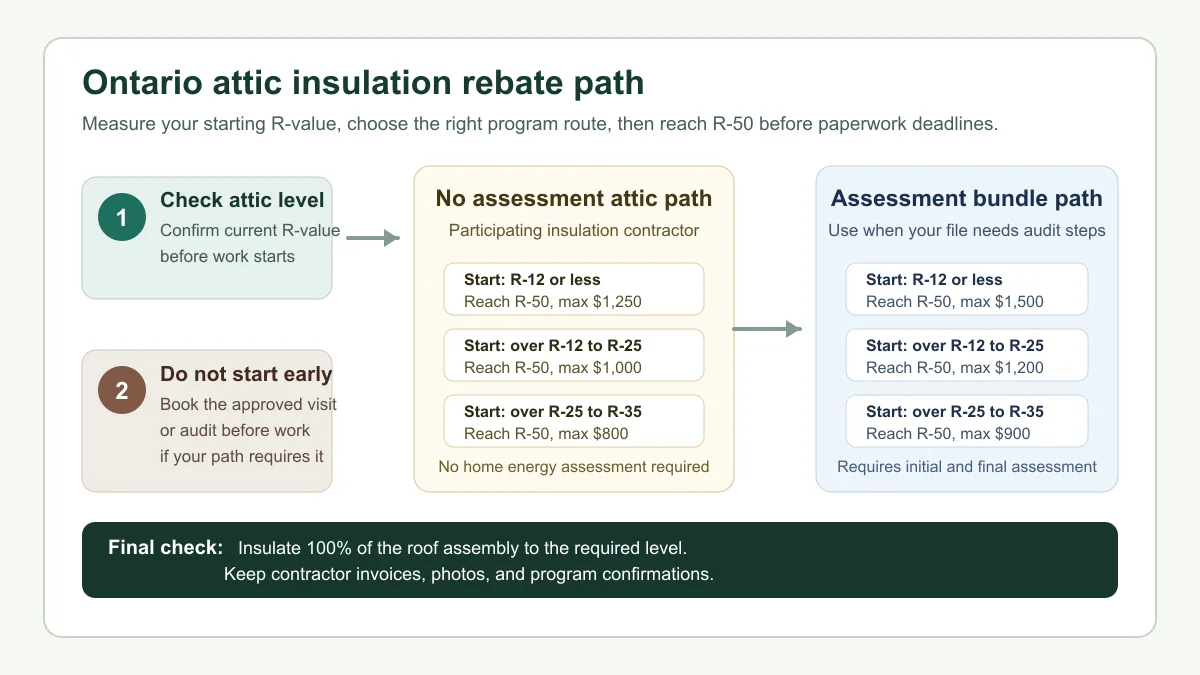
- Sort your current level into the right tier. For no-assessment attic work, the listed tiers are R-12 or less, greater than R-12 to R-25, and greater than R-25 to R-35. Each tier must reach at least R-50.
- Watch for mixed coverage. Many attics are not even. One area may be near R-12 while another is closer to R-25. Ask how the contractor will document the total area and the weakest sections.
- Take photos before air sealing or blowing insulation. Photos are not a substitute for program documentation, but they make it easier to challenge mistakes and understand what was actually improved.
Step 3: Compare R-12 to R-50 Rebate Amounts Without Mixing Programs
- Estimated time: 15 to 20 minutes. Write down both possible rebate paths before you choose the job scope. The no-assessment attic stream currently lists these maximums: R-12 or less to R-50, $1,250; greater than R-12 to R-25 to R-50, $1,000; greater than R-25 to R-35 to R-50, $800.
- Compare that with the assessment bundle. The official assessment path currently shows higher attic amounts: R-12 or less to R-50, $1,500; greater than R-12 up to R-25 to R-50, $1,200; greater than R-25 up to R-35 to R-50, $900.
- Do not chase the higher number blindly. An assessment file adds audit steps, timing rules, and usually at least two upgrades. The extra rebate may make sense if you already need other work, but it can be the wrong route for a simple attic top-up.
- Separate attic work from other envelope rebates. For basement, wall, header, crawlspace, and air sealing details, use the full Ontario insulation rebate guide so you do not force every insulation question into the attic rules.
Honestly, the R-12 threshold is where people get careless. If your attic starts at R-13 or R-18, it is not the same tier as R-12 or less, even if the attic still feels under-insulated.
Step 4: Choose the Right Contractor Before Work Starts
- Estimated time: 30 to 60 minutes. Complete the official process that gives you the appropriate contractor or service organization path. For attic-only work, the official page says to work with a participating contractor for attic, cathedral ceiling, flat roof, or a combination of those roof assemblies.
- Use a contractor who knows the attic stream. Our guide to Home Renovation Savings participating contractors explains what to ask before you sign, including who submits documents and how the rebate amount is shown on the quote.
- Do not authorize eligible work too early. The official attic page asks whether upgrades have already started, and the program process is built around confirming eligibility before the project moves ahead. Get the order right.
- Ask about the full roof assembly. The attic page says 100% of the total roof assembly must be insulated to qualify. That can include the attic, cathedral ceiling, flat roof, or a combination, depending on the home.
Step 5: Plan the Install So R-50 Is Actually Reached
- Estimated time: 45 minutes for planning, usually one installation day for a straightforward attic. Ask the contractor how they will reach R-50 across the attic, not just in easy open bays. Low edges, wind-washed soffit areas, attic hatches, and recessed lights often need attention.
- Fix obvious air leaks before burying them. Air sealing may be a separate rebate topic, but attic insulation performs better when leaks around plumbing stacks, wiring holes, fans, and attic hatches are handled correctly.
- Protect ventilation. R-50 should not block soffit ventilation or create moisture trouble. Baffles, proper clearances, and safe treatment around heat sources belong in the scope.
- Make the invoice match the program language. Look for the existing R-value, final R-50 target, insulated area, product type, installation date, taxes, and paid amount. I've seen clean invoices move faster than vague ones.
Step 6: Submit and Track the Attic Insulation Rebate Ontario R-12 to R-50 2026 Claim
- Estimated time: 30 minutes for homeowner follow-up after the contractor submits their part. Ask exactly who submits the application, what documents you should receive, and when you should expect the rebate review.
- Keep every file in one folder. Save intake confirmations, contractor emails, before-and-after photos, quote versions, invoices, payment receipts, and any program messages. Boring paperwork wins here.
- Watch the 2026 timing. The official attic page includes 2026 program language and deadlines can differ by stream. Confirm current dates before signing, especially if your project is late in the year.
- Check payment details before you close the job. Make sure the name, property address, contractor, and final invoice are consistent. Small mismatches can slow the rebate file.
Related Ontario Rebates to Check Before You Decide
- Estimated time: 30 to 45 minutes. If your attic job is part of a larger plan, compare insulation with the window rebate Ontario 2026 guide, the heat pump water heater rebate, and air sealing rules before choosing the assessment path.
- Look at HVAC rebates separately. Insulation can reduce heating and cooling loads, but a heat pump decision needs its own math. Review heat pump cost math, the Enbridge heat pump rebate, the Ontario heat pump rebate program, and the heat pump rebate with no energy assessment if HVAC is on your list.
- Keep non-insulation upgrades in their own lane. The smart thermostat rebate, solar battery storage rebate, and EV charger installation cost planning can affect your budget, but they do not prove your attic qualifies.
- Check financing without assuming it is open. If cash flow is tight, read the current Canada Greener Homes Loan status before treating loan money as part of the project plan.
Quick Checklist
- Confirm your current attic level before adding insulation.
- Choose no-assessment attic work or the assessment bundle before comparing rebate amounts.
- Use the official path to find a participating insulation contractor or service organization.
- Make sure the scope reaches R-50 across the required roof assembly area.
- Do not start eligible work before the required program step is complete.
- Keep photos, quotes, invoices, payment proof, and program messages together.
- Verify current 2026 deadlines and rebate amounts before signing.
Handled carefully, an attic insulation rebate Ontario R-12 to R-50 2026 claim is not complicated. Measure first, pick the right route, use the right contractor, and keep the file clean until the rebate is paid.
Frequently Asked Questions
how much is the attic insulation rebate in Ontario for R-12 to R-50 in 2026?
For the no-assessment attic stream checked on June 7, 2026, the official page lists a maximum of $1,250 when attic insulation starts at R-12 or less and reaches R-50. The assessment path lists $1,500 for the same R-12-or-less to R-50 attic upgrade when the assessment-route requirements are met.
do I need a home energy assessment for attic insulation rebate Ontario?
Not always. The official attic insulation page says a home energy assessment is not required for its attic stream. You may still need an assessment if attic insulation is part of a broader multi-upgrade file under the assessment route.
can I get an attic insulation rebate if I already started the work?
Maybe not. The safest answer is to pause and verify before continuing. Rebate programs often require eligibility checks, contractor steps, or assessments before work starts, and attic work is difficult to document after insulation has been added.
what R-value do I need for the Ontario attic insulation rebate?
The attic rebate tiers discussed here require the attic insulation to reach at least R-50. Your starting level affects the maximum rebate, with separate tiers for R-12 or less, greater than R-12 to R-25, and greater than R-25 to R-35.
who can install attic insulation for the Ontario rebate?
Use the contractor route provided by the Home Renovation Savings process. For the attic stream, the official page says to work with a participating contractor for attic, cathedral ceiling, flat roof, or a combination of those roof assembly areas.
is R-50 attic insulation worth it in Ontario?
Often, yes, especially when an older attic is near R-12 or lower. R-50 can improve winter comfort, reduce summer heat gain, and lower heating and cooling demand, but the best value depends on air leaks, ventilation, attic access, and the net cost after rebate.